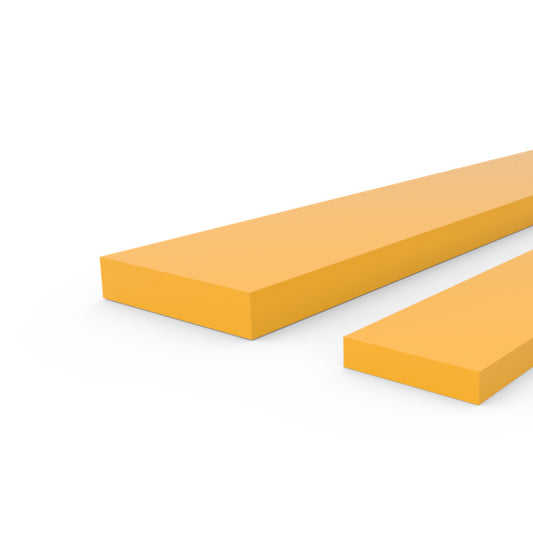
What are plastic strips?
Plastic strips, sometimes referred to as polymer strips in technical contexts, are flat, elongated profiles manufactured from engineering polymer materials. They are used for protection, spacing, sealing, or guiding purposes in technical and industrial applications.
These strips are typically produced from a range of engineering plastics, depending on the required mechanical and chemical properties. They are supplied in standard lengths or cut to size according to specification.
Plastic strips are valued for their lightweight properties, resistance to moisture and chemicals, dimensional stability, and ease of installation. Their simple geometry makes them suitable for a wide range of uses where either flexible or rigid strip material is required.
Applications of plastic strips
Plastic strips are used across multiple industries, including industrial manufacturing, marine applications, construction, and equipment assembly. Their material properties make them suitable for environments where corrosion resistance, low friction, or mechanical durability is required.
Plastic wear strips
Plastic wear strips are applied in systems where surfaces are subject to continuous contact or movement. They reduce friction, minimize wear on mechanical components, and extend service life. Materials such as UHMWPE, POM, and PTFE are commonly used for wear-resistant applications.
Plastic guide strips
Plastic guide strips are used in mechanical systems to support linear movement or maintain component alignment. They provide dimensional stability while reducing noise and vibration. Engineering plastics such as POM, nylon (PA), and UHMWPE are often selected for these applications.
Plastic edge protection strips
Plastic edge protection strips are installed to shield edges, surfaces, or structural components from impact, abrasion, or environmental exposure. HDPE, PVC, and polyurethane are frequently used where corrosion resistance and mechanical protection are required.